1. Understand What You Are Paying For
When buying a tenanted property, you are acquiring the property together with an existing tenancy, subject to the terms of the transaction and tenancy agreement.
The rental income may help support your investment calculations, but you should understand exactly what you are paying for.
Consider a hypothetical commercial property asking S$2 million with an existing tenant paying S$8,000 per month.
That represents annual rental income of S$96,000 and an indicative gross rental yield of 4.8%, before expenses.
At first glance, the numbers may appear attractive.
But you still need to establish whether the rent is sustainable, how long the tenancy has left and whether the purchase price is reasonable for the property.
For a vacant unit, you would instead need to estimate a realistic achievable rental based on comparable properties, tenant demand and the unit's characteristics.
Do not assume the vacant unit can immediately achieve the rental you hope for.
In both cases, the important question is whether the purchase price makes sense relative to the income the property can realistically generate.
2. Examine the Existing Tenancy Carefully
An existing tenant can provide useful information about the property's income potential.
However, the existence of a tenancy alone does not tell you whether the income is attractive or sustainable.
Before buying, understand the key terms of the tenancy agreement, including:
- The commencement and expiry dates.
- The current monthly rental.
- Any contractual rental increases.
- Renewal options, if applicable.
- Security deposit arrangements.
- Relevant obligations and restrictions under the agreement.
You should also understand the tenant's business and whether the premises appear suitable for its ongoing operations.
A tenant paying rent today may not necessarily renew when the lease expires.
Likewise, the presence of a well-known company does not automatically make a property a good investment at any asking price.
The important question is not simply whether the property is tenanted, but what the existing tenancy actually contributes to the investment.
3. Compare the Current Rent With Market Rent
One of the most important checks when buying a tenanted property is whether the existing rent is broadly in line with the market.
Imagine two properties with similar characteristics.
Property A has a tenant paying S$10,000 per month, while Property B is vacant.
If comparable units suggest that achievable rent is closer to S$7,500 per month, Property A's current income may not be sustainable at the same level when the tenancy ends.
The existing tenant could still represent a valuable income stream for the remaining lease period. However, your investment assessment should account for the possibility of a lower rental when the unit is re-let.
For a vacant property, the challenge is different.
You need to assess whether your expected rental is realistic and how long it might take to secure a suitable tenant.
For both options, examine comparable rental evidence where available, rather than relying solely on an asking rental or an agent's estimate.
This helps you avoid overestimating the property's future income.
4. Consider the Risk of Vacancy
A tenanted property may provide income from an existing lease, but that does not eliminate vacancy risk.
When the tenancy expires, you may need to find a replacement tenant, negotiate a new rental or carry the property without rental income for a period.
You may also incur leasing expenses, repairs or fit-out costs, depending on the circumstances and the terms of the tenancy.
A vacant property presents a more immediate challenge.
Until you secure a tenant, you may need to fund the property's holding costs without rental income.
These could include financing costs, maintenance charges, property tax and other expenses, depending on the property and your circumstances.
Before committing, ask yourself:
- How long might it realistically take to find a tenant?
- Is there evidence of demand for this type of unit?
- What rental could the property reasonably achieve?
- Can I cover the holding costs if the unit remains vacant longer than expected?
The answers will help you assess whether the investment fits your available capital and tolerance for uncertainty.
5. Assess the Property's Appeal to Future Tenants
Whether a property is currently tenanted or vacant, its underlying characteristics matter.
A tenant may occupy a unit because it suits a specific business. But that does not guarantee the same unit will appeal to other businesses.
For an office, consider accessibility, layout, building facilities and the needs of potential occupiers.
For retail, consider frontage, visibility, pedestrian movement, customer access and suitability for the intended use.
For industrial property, examine factors such as approved use, loading access, ceiling height, floor loading and the operational requirements of potential tenants.
The more specialised the unit, the more carefully you should evaluate its potential replacement tenant pool.
A vacant unit with desirable characteristics may offer an opportunity to secure a tenant on terms that suit your strategy.
However, that potential is only valuable if there is realistic demand and the property can be leased on commercially sensible terms.
6. Look at the Purchase Price and Total Investment Cost
A tenanted property may command a premium because it offers existing rental income. A vacant property may be priced differently because the buyer must take on the leasing process.
But neither should be evaluated based on price alone.
For a tenanted property, consider whether the current rental income justifies the asking price and whether the tenancy's remaining duration supports your investment objectives.
For a vacant property, consider the purchase price alongside the likely achievable rent, expected vacancy period and costs required before occupation.
You should also account for acquisition costs, applicable stamp duties, GST where applicable, legal fees, financing and other relevant expenses.
For a vacant unit, additional fit-out or repair costs may be necessary, depending on its condition and intended use.
A lower purchase price does not automatically make a vacant property the better deal. Equally, an existing tenant does not justify paying any premium.
Compare the total investment required and the realistic income potential of each property.
7. Decide Which Option Fits Your Investment Strategy
The final decision depends on what you want from the property.
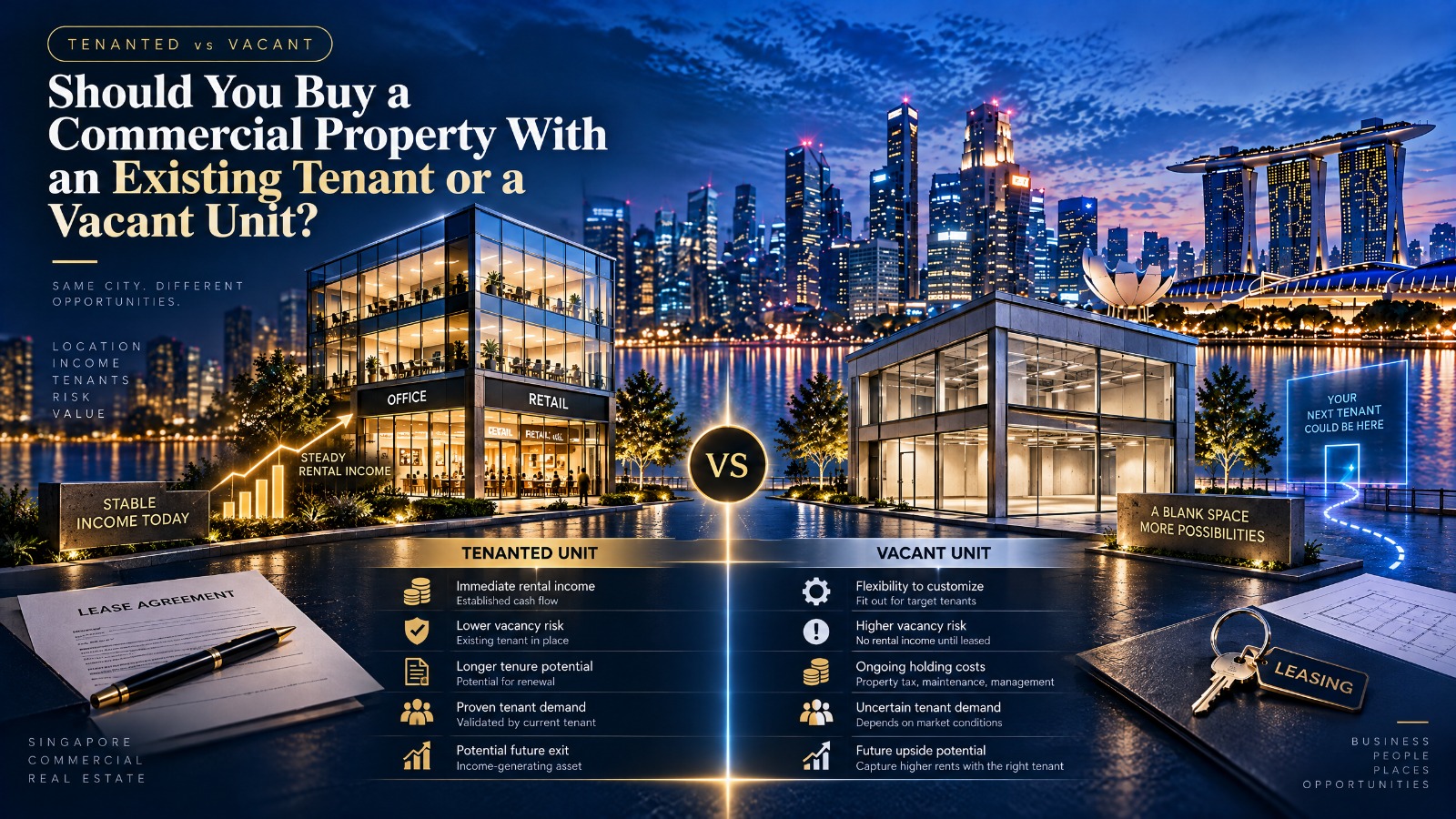
A tenanted property may suit an investor who values existing rental income and has assessed the tenant, lease terms and sustainability of the rent.
A vacant property may suit a buyer who has identified a potential leasing opportunity, wants greater flexibility over occupation or believes the purchase price reflects the work and risk involved in securing a tenant.
However, neither option is inherently safer or more profitable.
A tenanted property with a short remaining lease and an unsustainable rental may carry significant uncertainty.
A vacant property in a location with weak tenant demand may take longer to lease than expected.
The decision should therefore consider the entire investment proposition, including price, property characteristics, achievable rent, expenses, vacancy risk and future resale potential.
Before making an offer, ask yourself:
Am I buying an income stream I understand, or am I relying on an assumption about what the property could earn?
That distinction can make a significant difference to your decision.
The Lightbulb Moment: An Existing Tenant Is an Advantage Only If the Numbers Make Sense
It is easy to assume that a tenanted property is automatically preferable because rental income is already coming in.
But the tenant is only one part of the investment.
You still need to understand the rental rate, remaining lease, tenant profile, property condition, purchase price and demand from future occupiers.
Likewise, a vacant unit should not be dismissed simply because it is not generating rent today.
It may offer potential, but you need evidence that the expected rental, leasing timeline and total costs make sense.
Do not buy a tenanted property simply because it has a tenant. Do not buy a vacant property simply because you believe you can rent it out later.
Understand the numbers, assess the risks and decide whether the opportunity fits your objectives.
The Bottom Line
Both tenanted and vacant commercial properties can offer investment opportunities, but each comes with different considerations.
Before buying, assess:
- The purchase price and total capital required.
- The existing tenancy and its remaining duration, if applicable.
- Whether the current or expected rental is realistic.
- The likelihood and potential cost of vacancy.
- The property's suitability for future tenants.
- Your ability to manage holding costs and uncertainty.
- Your intended holding period and potential exit.
An existing tenant can provide income visibility, while a vacant unit may offer flexibility. Neither guarantees a better investment.
The right choice is the property whose price, income potential and risks make sense for your investment strategy.
If you are considering a commercial or industrial property in Singapore, I can help you assess the opportunity beyond its current tenancy status and advertised rental yield.
Call or WhatsApp Patrik @ 9328 9376 to discuss your requirements.
Call or WhatsApp Patrik @ 9328 9376Disclaimer: This article is for general educational purposes only and does not constitute financial, investment, legal or tax advice. Property investments involve risks, and rental income, capital appreciation and resale outcomes are not guaranteed.
What's Next?
Buying a commercial property for rental income is one objective. Buying a property for your own business is another.
An investor may focus on rental yield, tenant demand and resale potential. An owner-occupier may prioritise operational suitability, accessibility, layout and the long-term needs of the business.
Sometimes these objectives overlap, but they do not always lead to the same property choice.
In the next article, I'll examine Commercial Property for Investment or Own Business Use Which Should You Choose? and the factors to consider before deciding whether to buy a property as an investment or for your own operations.
Continue to Article 17 → (coming next)
Working through a similar brief?
Send the details — you'll get a real reply, not a templated one.
Send an enquiry