1. Start With Your Investment Objective
Before comparing office and retail units, decide what you want the property to achieve.
Are you looking for rental income? Do you prefer a property that may also suit your own business in the future? Are you prioritising long-term ownership, capital preservation or potential resale demand?
Different objectives can lead to different property choices.
An investor who prioritises rental income may focus on the rent, tenant profile and ongoing expenses.
An owner-occupier may care more about accessibility, layout, visibility and whether the unit supports business operations.
Someone intending to hold the property for many years may place greater emphasis on tenure, maintenance obligations and the property's long-term suitability.
Without a clear objective, it is easy to choose a property simply because its advertised yield looks attractive.
2. Understand Who Your Potential Tenants Are
Office and retail properties serve different business needs.
Office tenants may include professional services firms, consultancies, technology businesses and other companies requiring workspace.
Retail tenants may include shops, service businesses and food and beverage operators, subject to the property's approved use and relevant restrictions.
However, the tenant pool depends on the specific property.
An office in a convenient location with a practical layout may suit a range of businesses. A retail unit with good visibility may attract tenants who depend on customer access and exposure.
But a retail unit hidden from the main pedestrian flow may have a very different proposition from one facing a busy street.
Likewise, an office unit with an awkward layout or poor accessibility may struggle to compete with alternatives.
When evaluating either property, ask:
- Who is likely to rent this unit?
- What makes this location suitable for their business?
- How many realistic alternatives do potential tenants have?
- If the current tenant leaves, how difficult might it be to find a replacement?
The important consideration is not simply the type of property. It is the strength of demand for that particular unit.
3. Compare Location at the Unit Level
A CBD address can be attractive, but the district name alone does not determine a property's rental or resale potential.
For office units, consider proximity to MRT stations, accessibility for employees and clients, building facilities, the surrounding business environment and the unit's layout.
For retail units, consider frontage, visibility, pedestrian movement, surrounding businesses, customer access and the relationship between the unit and its immediate surroundings.
Even within the same building, different units can have different advantages.
A retail unit facing a prominent street may appeal to a different tenant pool from an internal unit on an upper floor.
An office unit with a practical layout and convenient access may compete differently from one with less desirable characteristics.
Do not compare only the district or building. Understand what makes the individual unit attractive to its intended occupiers.
4. Look Beyond the Advertised Rental Yield
Rental yield is an important starting point, but it does not tell you everything about an investment.
Suppose you are comparing two hypothetical properties:
Office Unit A
- Purchase price
- S$2,000,000
- Annual rental income
- S$80,000
- Gross rental yield
- 4%
Retail Unit B
- Purchase price
- S$2,000,000
- Annual rental income
- S$100,000
- Gross rental yield
- 5%
At first glance, Retail Unit B appears more attractive because it generates a higher gross rental yield.
But what if its tenancy expires sooner? What if its current rent is above comparable market levels? What if its location makes it more difficult to attract a replacement tenant?
Conversely, the office unit may have its own weaknesses, such as stronger competition from similar units or a rental rate that is difficult to sustain.
The figures alone do not tell you which investment is better.
You would need to examine the lease, current rental conditions, expenses, property characteristics and potential vacancy risks.
Remember that gross rental yield does not account for operating expenses, vacancy, financing costs or acquisition expenses.
The objective is to understand the income you may realistically retain, not simply the percentage displayed in the listing.
5. Consider Tenure and Total Acquisition Cost
Tenure can influence both the price you pay and the future buyer's assessment of the property.
A freehold office unit may command a premium compared with a broadly comparable leasehold property. A retail unit may also carry a premium because of its tenure, location or other characteristics.
But a premium does not automatically make the property a better investment.
Consider the total cost of acquiring the property, including the purchase price, applicable stamp duties, GST where applicable, legal fees and other transaction costs.
Then assess the property's income and potential exit.
For leasehold properties, consider the remaining lease rather than relying solely on the original lease term.
Also consider whether the property is suitable for your intended holding period and how its tenure may affect future buyers.
The right comparison is not simply freehold office versus leasehold retail, or vice versa.
It is the complete investment proposition of each property.
6. Think About What Happens When the Tenant Leaves
An existing tenant can make a property more appealing to an investor because rental income is already being generated.
However, the current tenancy should not be the only reason you consider buying.
For an office, ask whether other businesses would find the unit suitable. Consider its size, layout, accessibility, building facilities and asking rent.
For retail, consider whether the unit has characteristics that potential replacement tenants would value, such as visibility, frontage, customer access and suitability for their intended business.
Also examine the tenancy agreement, remaining lease, rental rate and any relevant restrictions.
A unit may have a strong current tenant but limited demand from replacement tenants.
Another unit may be vacant but have characteristics that appeal to a wider range of potential occupiers.
Neither situation guarantees a better investment. The key is to understand the risks and the reasons behind the property's current rental position.
Before buying, ask yourself:
If the current tenant leaves, would I still be comfortable owning this property?
7. Consider Your Future Exit
Your investment decision should account for the possibility that you may eventually want to sell.
Who is likely to buy the property from you?
An investor may focus on rental income, yield, tenure and future demand.
An owner-occupier may be more concerned about whether the property suits their business requirements.
The eventual buyer pool depends on the individual property and market conditions at the time of sale.
For an office unit, the future buyer may assess accessibility, building quality, unit size, layout, remaining lease and the demand for similar office space.
For a retail unit, frontage, visibility, tenant demand, location, permitted use and the property's price may influence its appeal.
Consider how easily the property could be explained to a future buyer.
Does it offer a clear investment proposition? Does it serve a recognisable occupier need? Is the asking price likely to be competitive against alternative opportunities?
No property is guaranteed to sell quickly or appreciate in value. However, thinking about your eventual exit before buying can help you identify potential weaknesses early.
The Lightbulb Moment: Do Not Choose the Property Type Before Understanding the Opportunity
It is tempting to ask whether office or retail property is the better investment.
But that question can lead you in the wrong direction.
A well-located office unit with sustainable rental income may suit one investor. A retail unit with a suitable tenant, practical layout and strong occupier demand may suit another.
At the same time, either category can contain properties that are overpriced, difficult to lease or poorly suited to the buyer's objectives.
The property type is only one part of the decision.
The more useful question is: Which individual property offers the most suitable balance of price, income, tenant demand, risk and resale potential for me?
Start with your objectives. Understand your budget. Then compare the actual opportunities available.
You may find that an office is the better fit. You may find that retail makes more sense. You may even decide that neither is suitable at the moment.
That is a more considered approach than choosing a property simply because its headline yield looks attractive.
The Bottom Line
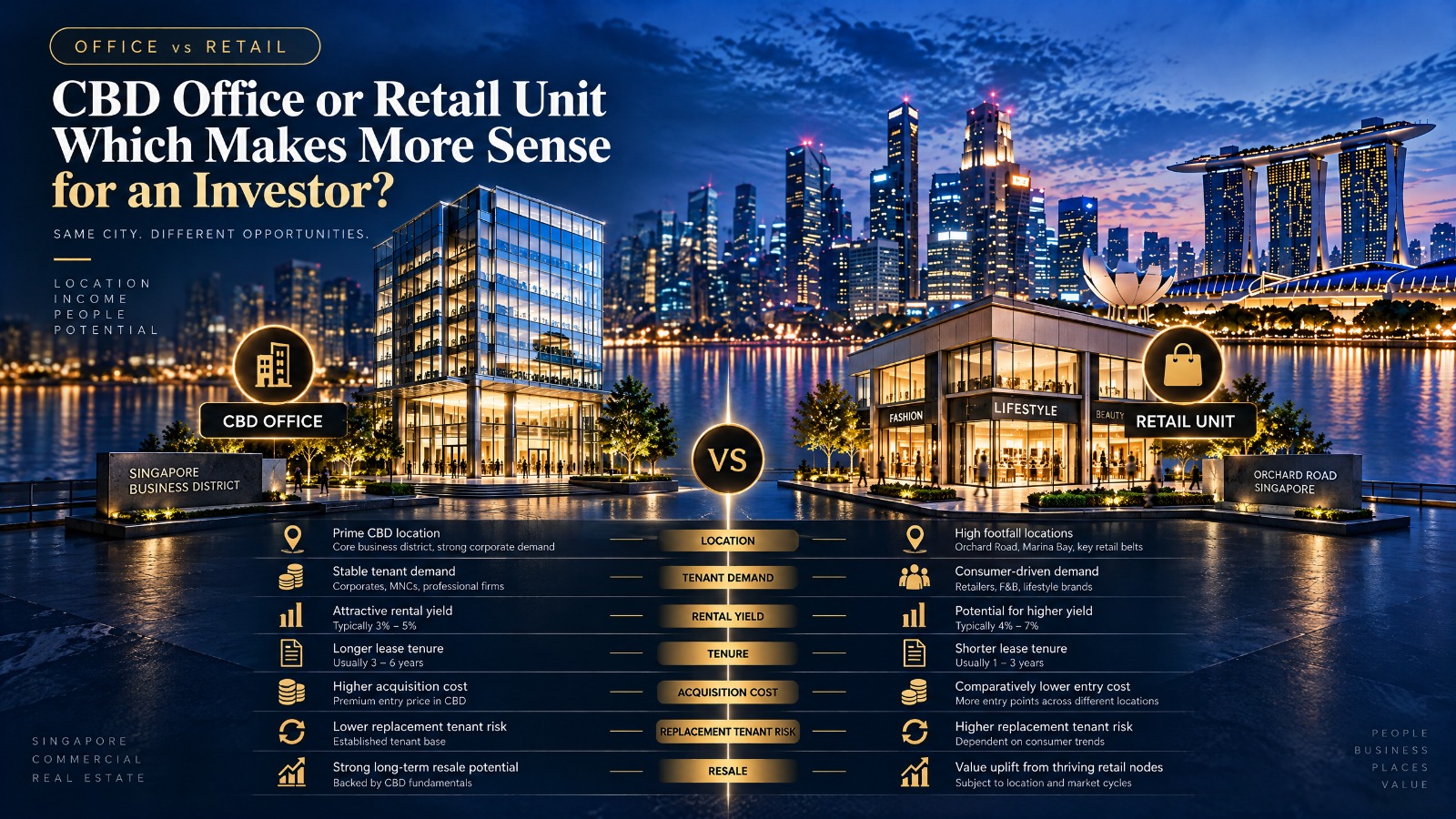
CBD office and retail units can both form part of a commercial property investment strategy, but they offer different characteristics and serve different occupier needs.
Before deciding, consider:
- Your investment objective and available capital.
- The likely tenant pool and demand for the individual unit.
- Location, accessibility, visibility and physical characteristics.
- Rental income, lease terms and potential vacancy.
- Tenure and total acquisition cost.
- Replacement tenant demand.
- Your potential future buyer and exit strategy.
There is no universal answer to whether office or retail is the better choice.
The right decision depends on the individual property, its price, the income it can realistically generate and how well it fits your investment objectives.
If you are considering an office or retail unit in Singapore, I can help you compare suitable opportunities beyond their asking prices and advertised yields.
Call or WhatsApp Patrik @ 9328 9376 to discuss your requirements.
Call or WhatsApp Patrik @ 9328 9376Disclaimer: This article is for general educational purposes only and does not constitute financial, investment, legal or tax advice. Property investments involve risks, and rental income, capital appreciation and resale outcomes are not guaranteed.
What's Next?
Choosing between an office and a retail unit is one decision. Another is deciding whether to buy a property with an existing tenant or purchase a vacant unit.
An existing tenancy may provide immediate rental income, but a vacant property may offer greater flexibility for certain buyers.
Which option makes more sense for an investor?
In the next article, I'll examine the considerations behind buying a tenanted commercial property versus a vacant one, including rental sustainability, vacancy risk and flexibility.
Working through a similar brief?
Send the details — you'll get a real reply, not a templated one.
Send an enquiry