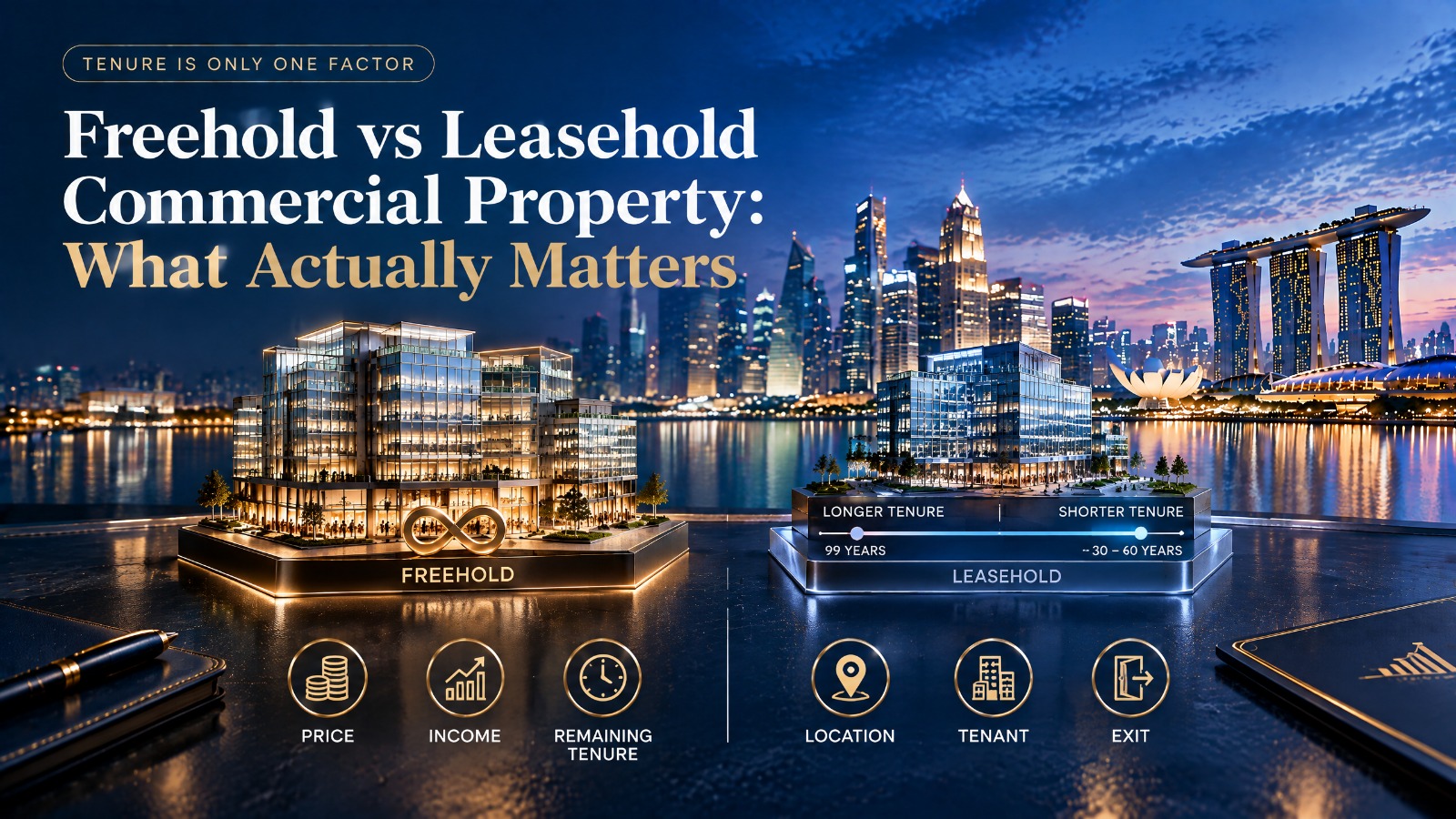
1. Start With What the Tenure Actually Means
The first step is simply to understand what you are buying.
Commercial properties in Singapore can have different tenures, including freehold and various leasehold arrangements.
But the label alone does not tell you enough.
For a leasehold property, you need to understand:
- When the lease commenced
- The original lease period
- How much time remains
- Whether there are any specific lease conditions
- How the remaining tenure fits your investment horizon
A property described simply as “99-year leasehold” doesn't tell you whether the lease started recently or decades ago.
Those are very different propositions.
This is why I prefer to look at remaining tenure, rather than simply the original tenure stated in the listing.
2. Freehold Does Not Mean Any Price Is Justified
This is where things become more interesting.
Imagine you are comparing two commercial properties.
Property A
- Tenure
- Freehold
- Price
- S$5 million
- Rent
- S$180,000 annual rent
- Yield
- 3.6% gross yield
Property B
- Tenure
- Leasehold
- Price
- S$3.5 million
- Rent
- S$175,000 annual rent
- Yield
- 5.0% gross yield
The freehold property has the stronger tenure characteristic.
But you still have to ask:
How much am I paying for it?
The freehold property requires significantly more capital while generating only slightly more rental income in this example.
That does not automatically make the leasehold property the better investment either.
Property B could have:
- Shorter remaining tenure
- Weaker tenant demand
- Lower resale liquidity
- Inferior location
- Different financing considerations
The point is simply that tenure has to be considered alongside price and income.
Freehold is not a substitute for valuation.
3. Look at Remaining Lease, Not Just “99 Years”
This is particularly important with leasehold commercial property.
Suppose you see:
99-year leasehold
Your next question should be:
“99 years from when?”
A newly created 99-year lease and a 99-year lease with several decades already elapsed are not the same proposition.
As remaining tenure decreases, it can become increasingly relevant to how the property is valued and how future buyers view it.
Singapore's land-value framework explicitly recognises residual lease tenure. For example, URA's Land Betterment Charge framework provides for leasehold adjustments where land has a residual unexpired tenure of 99 years or less.
That does not mean there is a simple percentage you can apply to every commercial property.
It means something more basic:
Remaining tenure is a factor worth examining.
4. 999-Year Leasehold Is a Different Conversation
This is where buyers sometimes lump very different properties together.
A property described as 999-year leasehold is technically leasehold.
But comparing a 999-year property with a leasehold property that has, for example, 50 years remaining purely because both are “leasehold” doesn't tell you much.
The practical question is:
How much tenure is actually remaining, and how does that compare with the buyer's intended holding period?
For example, if someone is looking for a long-term commercial asset, a property with a very long remaining tenure may be viewed differently from one with a substantially shorter remaining lease.
But again, the longer tenure does not remove the need to assess:
price + rental income + location + tenant + building + exit
Tenure is one component of the investment proposition.
5. Ask What the Property Is Being Used For
Tenure can mean different things to different buyers.
An investor may be focused on:
- Rental income
- Capital preservation
- Resale demand
- Long-term holding
- Future buyer pool
An owner-occupier may be more concerned with:
- Location
- Accessibility
- Business visibility
- Operational suitability
- Fit-out investment
- How long they expect to operate from the premises
That distinction matters.
A business that intends to occupy a property for the next 10 or 15 years may look at the tenure differently from an investor intending to hold the property for several decades.
The right tenure depends partly on what you are trying to achieve with the property.
6. Don't Assume Lease Renewal Is Guaranteed
This is another point buyers should understand.
If you are buying leasehold property, don't automatically build your investment case around the assumption that the lease will simply be extended later.
For State leases, the Singapore Land Authority states that lease renewal applications are considered on a case-by-case basis, taking into account the Government's long-term plans for the land and consultation with other agencies.
SLA also states that, in general, the Government's policy is to allow leases to expire without extension, while considering extensions where they align with planning intentions and specific economic or social objectives.
So if the investment thesis depends heavily on a future lease extension, that assumption needs to be treated carefully.
Buy the property based on what you know today, not on an assumed renewal tomorrow.
7. Think About the Exit Before You Buy
This brings us back to one of the biggest lessons from Series 1:
Who is going to buy this property from you later?
Imagine buying a leasehold commercial property because the rental yield looks attractive.
Ten years later, you decide to sell.
Your future buyer may look at:
- Remaining lease
- Purchase price
- Rental income
- Tenant profile
- Location
- Building quality
- Financing
- Intended use
- Resale potential
That means the tenure you are comfortable with today may not be viewed the same way by your future buyer.
The reverse can also be true.
A well-located leasehold property with strong underlying demand may continue to attract buyers because the property itself offers something they value.
This is why I don't look at tenure in isolation.
I look at how tenure affects the property's overall resale proposition.
The Lightbulb
Don't Ask Which Tenure Is Better
Ask:
“What am I paying for the tenure?”
That small change in thinking can completely change how you compare commercial properties.
Freehold may offer a long-term ownership characteristic that some buyers value.
A very long leasehold tenure can also provide a substantial remaining ownership period.
A shorter leasehold property may offer a different entry price and potentially a different yield, but the remaining tenure and eventual exit need to be considered carefully.
There is no universal answer.
Instead, compare:
Price + Income + Remaining Tenure + Location + Tenant + Risk + Exit
That is a much more useful way to look at commercial property.
The Bottom Line
Freehold is not automatically better.
Leasehold is not automatically worse.
And 999-year leasehold should not simply be treated as interchangeable with freehold just because the remaining tenure may be very long.
When comparing commercial properties, I would ask:
What is the tenure?
How much tenure remains?
What am I paying for it?
How does the price affect the rental yield?
Does the property suit my intended holding period?
Who is likely to buy it from me later?
The question isn't simply:
“Freehold or leasehold?”
It's:
“Does the tenure, price and income make sense for what I am trying to achieve?”
If you're comparing commercial properties with different tenures, feel free to share the details with me. I can help you look beyond the tenure label and assess the broader property proposition.
Call or WhatsApp Patrik @ 9328 9376This article is for general information only and does not constitute financial, investment, legal or tax advice. Buyers should conduct their own independent due diligence.
What's Next?
Tenure is only one part of the equation.
The next question is perhaps even more interesting:
Why do some commercial properties offer significantly higher rental yields than others?
Is the higher yield an opportunity?
Or is the market pricing in a risk that isn't immediately obvious from the listing?
In the next article, I'll look at Why Some Commercial Properties Have Higher Yields Than Others — and what can actually be sitting behind that attractive percentage.
Working through a similar brief?
Send the details — you'll get a real reply, not a templated one.
Send an enquiry